

When Self-Regulation Becomes Another Form Of Self-Control
On befriending our protective armor, understanding our survival-based regulation, and the messy lived practice of actually building safety

When I am overwhelmed, one of THE WORST things someone can say to me is, “Calm down.”
Not only is it not helpful, but it is also infuriating.
All my eldest daughter and redhead energy gets activated. It’s not fun, mostly for whoever told me to calm down.
I’ve watched it happen to others, and they hate it, too.
And yet — we say this to ourselves in times of high stress and strain. Calm down. Stop feeling this way. Relax, you are being too much.
This kind of critical self-talk only piles on an already burdened protective system and a strained nervous system.
I know because everything I knew about staying regulated got tested in the most personal way possible recently.
Someone within my sweet family navigated a health crisis, and staying consistently regulated… well, that did not happen.
Was I clear? Yes. Was I calm when I needed to be? Most of the time. Did I break down and have my hot mess moments? You betcha. And thankfully for all involved, no one told me to calm down when I was in my feelings.
Love and loving have a way of breaking you open, leaving your heart exposed. Sixteen Candles and Pretty in Pink did not prepare me for a more expansive way of loving.

So, when Deb Dana shared in our most recent Unburdened Leader podcast conversation the difference between self-regulation built on safety and self-regulation built on survival, I felt her answers in my body. And I suspect you will, too.
The recent event in my family changed me. It was a tangible, lived moment of moving from self-regulation rooted in survival to self-regulation rooted in safety and connection.
Our protective armor always has an origin story
I grew up in a home that was chaotic and unsafe.
And for a very long time, I was rewarded for what I learned from that experience: developing thick armor like Marvel’s Iron Man, with all the little pieces of armor clicking into place, click, click, click, click when activated. That ability to lock in and stay focused with an on-the-surface calm, no matter what was going on around me, served me.

And I know I am not alone in this ability.
And yet, underneath that armor was a lot of hurt, a lot of fear, a lot of, well, me — all getting neglected and stuffed away.
It’s messed up reflecting on how empowering it felt (and how normalized it was) to be rewarded not for being me, but for exiling parts of me away.
Here is what I know now: that was never self-regulation. That was survival. And there is a difference.
I keep witnessing how people pursue self-regulation at the expense of their well-being and self-trust.
And I see how many people I work with use work, perfectionism, people-pleasing, overachieving, and over-functioning to regulate.
Know your control trailheads
In my clinical work, in addition to treating the spectrum of trauma and shame, I also specialize in treating the disordered eating spectrum, particularly orthorexia, which is a term coined by Dr. Steven Bratman and is defined as an unhealthy obsession with being healthy.
There is a lot of moral meaning behind eating “clean,” “pure,” and “natural,” and if any food is ingested that does not fit those categories, this causes immense anxiety and rumination, leading to extreme measures taken to “get it out” of their bodies in order to feel safe and worthy.
This results in a really restrictive way of eating and living, which is exhausting and untenable.
I see the pursuit and expectation of always being regulated carrying the same rigidity that fuels orthorexia.
Underneath so much of the health and wellness messaging right now is control — controlling our emotions, our bodies, how we move, how we feed ourselves, how we look… and also controlling how we feel.
When you fear that any difficult emotion will take you out, there is a lot of effort to stay in control… until you can’t.
White-knuckling regulation is really control and power over. It is not owning your relationship with your body and your story.
Yes, exiling your emotions is often a reflexive response when you fear being misunderstood and conflict.
But when you protect and lead based on ‘shoulds’, you set yourself on a path toward burnout and disillusionment.
Doing the reps, not just thinking or talking about them
One of the most common questions I am asked is, “How do I get rid of that feeling inside that makes me dysregulated?”
Your relationship with your nervous system and your inner system has to be more than an intellectual process or a box to check.
If you try to build self-regulation practices without cultivating lived experiences of connection and safety — which involves moving through rupture, repair, and reconciliation, again and again and again — your nervous system will not trust you to take these risks if you just keep pushing through and overriding what you are actually feeling.
Some lived experiences that actually build this practice:
The moment you mess up, and you don’t exile parts of you or your emotions, but befriend them instead
When you disappoint someone and choose self-kindness anyway
When you allow for an imperfect repair after the rupture instead of avoiding
When you catch your armor locking in and get curious instead of self-critical
The more you befriend discomfort and unburden what weighs you down, the more you have the capacity to feel, care, and love. And for those of us who spent years in hyper-controlled and protected ways of moving through life, that openness can feel genuinely dangerous.
Loving deeply and taking ownership of your life and responsibilities is freakin’ hard.
We still put so much pressure on ourselves and others to have it all together, as if having it all together means not feeling difficult emotions or being vulnerable. Hard stop: It does not.
We are human and will make mistakes. We are in systems that are pushing us to the brink.
And this pressure is why we see the upticks in substance use and abuse, workaholism, mental health crises, people leaning on comfort and soothing through sex and drugs and shopping and gambling.
And sometimes, feeling dysregulated is a very healthy response to a lot of messed-up situations and challenges happening in your life, work, and the world right now.
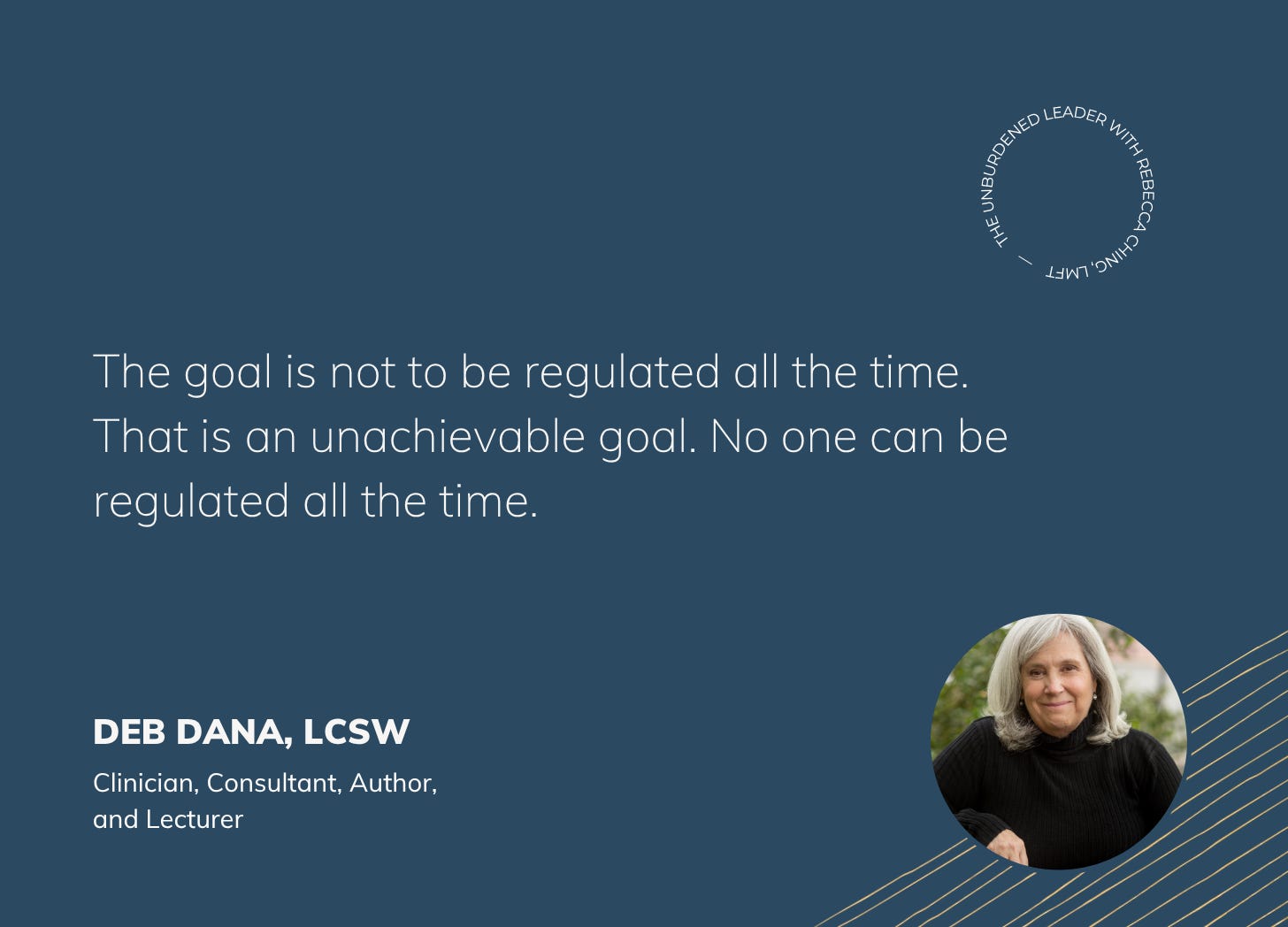
Deb wisely shared in our conversation, the goal is not to be regulated all the time. But instead, committing to building real, lived experiences of safety and connection. This means moving through the ruptures, doing the repairs, and repeating again and again.
I work with leaders and their teams. When I support you, I am always thinking about the whole system you are in. Your nervous system sets the tone. Your protectors shape the room. And your capacity for repair becomes the culture.
If you are ready to go deeper — for yourself, for your team, or both — book a connection call at rebeccaching.com.
Excellent piece!
I love this so much! Thank you